GladeCore
GladeCore
GladeCore
GLADE STUDIO
2026

Role
Founding Designer
Founding Designer
Timeline
4mo to beta
4mo to beta
Team
5 people
5 people
OVERVIEW
OVERVIEW
On-device AI for games.
On-device AI for games.
On-device AI for games.
GladeCore is a local LLM that gives game characters real, conversational intelligence. It runs AI inference, text-to-speech (TTS), and speech-to-text (STT) entirely on the player's own device.
The interface allows developers to easily adjust character personalities with customizable presets for emotionally-rich, expressive story-telling at low-latency for real-time, immersive responses during gameplay.
GladeCore is a local LLM that gives game characters real, conversational intelligence. It runs AI inference, text-to-speech (TTS), and speech-to-text (STT) entirely on the player’s own device.
The interface allows developers to easily adjust character personalities with customizable presets for emotionally-rich, expressive story-telling at low-latency for real-time, immersive responses during gameplay.

THE IMPACT
THE IMPACT
A lightweight solution.
A lightweight solution.
A lightweight solution.
GladeCore runs entirely on-device with no servers, no per-use cost, and no cloud latency. This means players can interact with AI-driven NPCs and storytelling as much as they like without the developers worrying about operating expenses.
GladeCore also solves the issue of large plugin footprints by offering lightweight versions that don’t compromise in-game performance. Responsive, private, and production-ready AI characters across multiple platforms.
GladeCore runs entirely on-device with no servers, no per-use cost, and no cloud latency. This means players can interact with AI-driven NPCs and storytelling as much as they like without the developers worrying about operating expenses.
GladeCore also solves the issue of large plugin footprints by offering lightweight versions that don’t compromise in-game performance. Responsive, private, and production-ready AI characters across multiple platforms.
< 0.2ms
< 0.2ms
Response time
< 400 MB
< 400 MB
Model sizes
180+
180+
Downloads
99%
99%
Lower AI costs
THE PROBLEM
THE PROBLEM
The hidden cost of using AI in games.
The hidden cost of using AI in games.
The hidden cost of using AI in games.
When I first joined Glade, we were developing an RPG with AI-driven storytelling. We integrated cloud-based AI to bring our NPCs to life, giving them memory, emotional nuance, and real-time conversational abilities. Our characters had depth, and players loved it. But halfway through our initial testing, the system stopped responding. We had unknowingly hit our usage limit.
It was a moment of clarity. The more engaging our AI became, the more fragile and expensive it was to maintain. We started digging into alternatives, but quickly noticed four recurring roadblocks that made current solutions a poor fit for games.
When I first joined Glade, we were developing an RPG with AI-driven storytelling. We integrated cloud-based AI to bring our NPCs to life, giving them memory, emotional nuance, and real-time conversational abilities. Our characters had depth, and players loved it. But halfway through our initial testing, the system stopped responding. We had unknowingly hit our usage limit.
It was a moment of clarity. The more engaging our AI became, the more fragile and expensive it was to maintain. We started digging into alternatives, but quickly noticed four recurring roadblocks that made current solutions a poor fit for games.
Cost
Cost
Most commercial tools charge per token or per query. The more engaging the conversations are, the steeper the costs. While manageable at first, ultimately, this pricing model punishes success.
Most commercial tools charge per token or per query. The more engaging the conversations are, the steeper the costs. While manageable at first, ultimately, this pricing model punishes success.
Latency
Latency
Even under good conditions, cloud-based models introduce a 1-3 second delay. In gameplay, that lag feels disruptive. It turns fluid conversation into awkward waiting, undermining the immersion. The magic of real-time interaction disappears.
Even under good conditions, cloud-based models introduce a 1-3 second delay. In gameplay, that lag feels disruptive. It turns fluid conversation into awkward waiting, undermining the immersion. The magic of real-time interaction disappears.
Customization
Customization
Devs want their characters to feel like they belong in the world, but most tools offered limited control over how the model behaved. Prompt engineering could only go so far, and vendor-controlled fine-tuning was often inaccessible or complex.
Devs want their characters to feel like they belong in the world, but most tools offered limited control over how the model behaved. Prompt engineering could only go so far, and vendor-controlled fine-tuning was often inaccessible or complex.
Connectivity & Privacy
Connectivity & Privacy
The AI couldn’t function without an internet connection. All interactions are routed through third-party servers, which also raises red flags for accessibility and privacy. This makes shipping AI games difficult and risky.
The AI couldn’t function without an internet connection. All interactions are routed through third-party servers, which also raises red flags for accessibility and privacy. This makes shipping AI games difficult and risky.
None of the existing tools offered a combination of control, speed, cost-efficiency, and offline access that we needed. So we built our own.
None of the existing tools offered a combination of control, speed, cost-efficiency, and offline access that we needed. So we built our own.
DESIGN EXPLORATION
DESIGN EXPLORATION
Designing the core experience around game devs.
Designing the core experience around game devs.
Designing the core experience around game devs.
Design concepts began with low-fidelity sketches to map out core features and explore layout possibilities. Sharing these with stakeholders surfaced quick, actionable feedback, pushing the design direction forward and narrowing in on what the product really needed to be.
Design concepts began with low-fidelity sketches to map out core features and explore layout possibilities. Sharing these with stakeholders surfaced quick, actionable feedback, pushing the design direction forward and narrowing in on what the product really needed to be.
Creating the main workspace.
Creating the main workspace.
With other tools, configuring the AI model typically requires developers to manually enter values through a terminal. For example, setting a trait with a command like hostility = 75. While functional, this workflow offered little visual feedback and made experimentation feel less intuitive.
To address this, I established the model customization screen as the primary workspace, giving developers a dedicated space to experiment with personality trait sliders, configure emotion presets, write character lore, and provide sample dialogue that the AI can reference when generating behavior and responses.
With other tools, configuring the AI model typically requires developers to manually enter values through a terminal. For example, setting a trait with a command like hostility = 75. While functional, this workflow offered little visual feedback and made experimentation feel less intuitive.
To address this, I established the model customization screen as the primary workspace, giving developers a dedicated space to experiment with personality trait sliders, configure emotion presets, write character lore, and provide sample dialogue that the AI can reference when generating behavior and responses.

Testing character behavior.
Testing character behavior.
The chat testing screen was designed to give developers a dedicated space to interact with and evaluate the AI characters they create. Responses are generated using the character's configured traits and background, allowing developers to quickly assess whether the model behaves as intended.
When a response feels out of character, developers can provide immediate feedback using thumbs up or thumbs down controls, along with a short explanation of what should be improved. This feedback is instantly applied to the model, enabling a fast, iterative workflow where developers can refine character behavior in real time.
The chat testing screen was designed to give developers a dedicated space to interact with and evaluate the AI characters they create. Responses are generated using the character’s configured traits and background, allowing developers to quickly assess whether the model behaves as intended.
When a response feels out of character, developers can provide immediate feedback using thumbs up or thumbs down controls, along with a short explanation of what should be improved. This feedback is instantly applied to the model, enabling a fast, iterative workflow where developers can refine character behavior in real time.

PROTOTYPING WITH AI
PROTOTYPING WITH AI
Closing the gap between design and engineering.
Closing the gap between design and engineering.
Closing the gap between design and engineering.
Same AI-assisted workflow as GladeKit. I wireframe in Figma, prototype in Cursor, and ship with Claude Code.
Same AI-assisted workflow as GladeKit. I wireframe in Figma, prototype in Cursor, and ship with Claude Code.

USABILITY TESTING AND ITERATION
USABILITY TESTING AND ITERATION
Revealing how game devs actually use the product.
Revealing how game devs actually use the product.
Revealing how game devs actually use the product.
Early access users pushed GladeCore in directions the initial designs hadn't accounted for. In particular, hardware constraints were a point of friction that I hadn't caught.
Example: Designing for hardware flexibility.
Example: Designing for hardware flexibility.
Observation
Observation
Not all developers had high-end hardware, which caused performance and compatibility issues when AI models relied solely on GPU processing.
Not all developers had high-end hardware, which caused performance and compatibility issues when AI models relied solely on GPU processing.
Insight
Insight
Developers needed more control over how AI workloads were distributed based on their individual hardware capabilities.
Developers needed more control over how AI workloads were distributed based on their individual hardware capabilities.
Action
Action
We introduced CPU/GPU splitting, allowing users to optimize their model through custom allocation settings.
We introduced CPU/GPU splitting, allowing users to optimize their model through custom allocation settings.

Usability testing highlighted the importance of designing for a wide range of developer environments rather than optimizing for an ideal setup. This reinforced the value of giving developers flexibility while ensuring complex technical settings remain approachable and easy to understand.
To make these controls more intuitive, I designed a dedicated modal that simplified model management. A visual slider allows users to easily adjust CPU/GPU allocation by moving between performance and compatibility, while a model selection dropdown provides access to system-compatible models or the option to upload a custom GGUF file.
Usability testing highlighted the importance of designing for a wide range of developer environments rather than optimizing for an ideal setup. This reinforced the value of giving developers flexibility while ensuring complex technical settings remain approachable and easy to understand.
To make these controls more intuitive, I designed a dedicated modal that simplified model management. A visual slider allows users to easily adjust CPU/GPU allocation by moving between performance and compatibility, while a model selection dropdown provides access to system-compatible models or the option to upload a custom GGUF file.
SOLUTION
SOLUTION
On-device AI with zero per-use fees and zero cloud dependency.
On-device AI with zero per-use fees and zero cloud dependency.
On-device AI with zero per-use fees and zero cloud dependency.
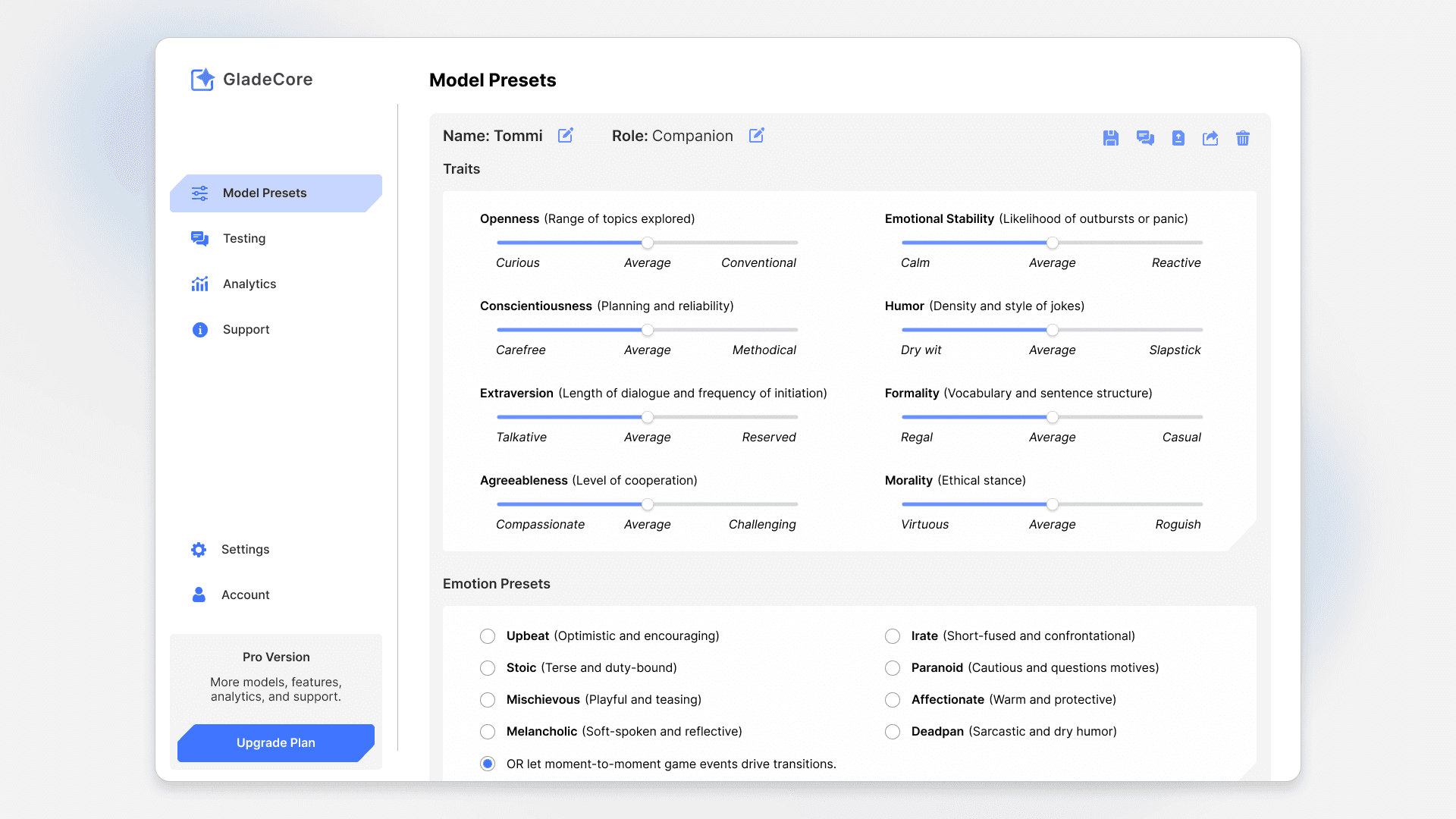
Main workspace allows developers to easily adjust model presets through personality sliders, lore details, and example dialogue.

The Plans tab displays each tier side by side, making it easy for users to compare options and choose the plan that best fits their needs.

The Testing tab lets users instantly test model responses and submit feedback.

The Model Presets tab also allows users to input character backstories and example dialogue to shape the model.

One-click to export model presets and import them directly into compatible game engines.
REFLECTION
REFLECTION
Designing AI that feels approachable.
Designing AI that feels approachable.
Designing AI that feels approachable.
Building on-device AI for games is about making advanced LLMs feel practical and approachable. While the technology behind local inference is complex, developers should be able to focus on creating immersive NPCs and dynamic stories instead of managing infrastructure, latency, or cloud costs.
My goal for GladeCore was to make integrating AI into games feel intuitive. I designed an interface that let developers configure, test, and deploy AI-driven characters with confidence, while keeping the power and privacy benefits of on-device models accessible to teams of any size.
I learned that the biggest design challenge wasn't simplifying machine learning concepts, it was making sophisticated AI capabilities feel understandable and trustworthy. Developers needed clear visibility into how models behaved, how they could be customized, and what trade-offs they were making. Designing for that level of transparency reinforced that good AI experiences aren't defined by how much complexity they hide, but by how clearly they communicate it.
Building on-device AI for games is about making advanced LLMs feel practical and approachable. While the technology behind local inference is complex, developers should be able to focus on creating immersive NPCs and dynamic stories instead of managing infrastructure, latency, or cloud costs.
My goal for GladeCore was to make integrating AI into games feel intuitive. I designed an interface that let developers configure, test, and deploy AI-driven characters with confidence, while keeping the power and privacy benefits of on-device models accessible to teams of any size.
I learned that the biggest design challenge wasn’t simplifying machine learning concepts, it was making sophisticated AI capabilities feel understandable and trustworthy. Developers needed clear visibility into how models behaved, how they could be customized, and what trade-offs they were making. Designing for that level of transparency reinforced that good AI experiences aren’t defined by how much complexity they hide, but by how clearly they communicate it.
What's next.
What’s next.
GladeCore has been downloaded by nearly 200 developers, and we're continuing to expand the platform. The next step is evolving it into a full SDK that supports deeper game engine integration and custom models, giving developers more flexibility to build AI-powered experiences that fit their workflows. I'm focused on making those advanced capabilities feel just as accessible and intuitive as the core platform.
GladeCore has been downloaded by nearly 200 developers, and we’re continuing to expand the platform. The next step is evolving it into a full SDK that supports deeper game engine integration and custom models, giving developers more flexibility to build AI-powered experiences that fit their workflows. I’m focused on making those advanced capabilities feel just as accessible and intuitive as the core platform.
THE PRODUCT
THE PRODUCT
Bring your NPCs to life with GladeCore.
Bring your NPCs to life with GladeCore.
Bring your NPCs to life with GladeCore.
GladeCore makes it easy for studios of all sizes to integrate AI into their games. Zero per-use fees, zero cloud dependency. That means game devs can design games that allow their players to engage in deep, expressive dialogue with NPCs, companions, and story events - all without worrying about privacy, latency, or scaling costs.
GladeCore makes it easy for studios of all sizes to integrate AI into their games. Zero per-use fees, zero cloud dependency. That means game devs can design games that allow their players to engage in deep, expressive dialogue with NPCs, companions, and story events - all without worrying about privacy, latency, or scaling costs.
GladeCore Website