GladeKit
GladeKit
GladeKit
GLADE STUDIO
2026

Role
Founding Designer
Founding Designer
Timeline
3mo to beta
3mo to beta
Team
3 people
3 people
OVERVIEW
Cursor for games.
Cursor for games.
Cursor for games.
GladeKit is an AI assistant built specifically for game developers. It connects AI agents directly to Unity, eliminating the copy-paste workflow that had become the unofficial standard for anyone using AI in game development.
As the lead designer at Glade Studio, I was responsible for every design decision. From defining what the product should be, to the interaction model, UI/UX architecture, and feature set. This is the story of how we got there.
GladeKit is an AI assistant built specifically for game developers. It connects AI agents directly to Unity, eliminating the copy-paste workflow that had become the unofficial standard for anyone using AI in game development.
As the lead designer at Glade Studio, I was responsible for every design decision. From defining what the product should be, to the interaction model, UI/UX architecture, and feature set. This is the story of how we got there.

THE IMPACT
From copy-paste loops to direct engine bridge.
From copy-paste loops to direct engine bridge.
From copy-paste loops to direct engine bridge.
GladeKit went from validated user pain to public beta in 3 months, and a stable v1 in 6. The work focused on removing that friction, so developers could use AI inside Unity without leaving the scene they were building in.
GladeKit went from validated user pain to public beta in 3 months, and a stable v1 in 6. The work focused on removing that friction, so developers could use AI inside Unity without leaving the scene they were building in.
320+
320+
Active developers
180
180
GitHub stars on MCP
41%
41%
Weekly retention
6 → 1
6 → 1
Steps in workflow
THE PROBLEM
AI was transforming coding, but game dev was left out.
AI was transforming coding, but game dev was left out.
AI was transforming coding, but game dev was left out.
Tools like Cursor and Copilot had made AI-assisted coding mainstream, but game developers were still wrestling with the complexity of game engines.
To get AI help, you'd describe your problem in ChatGPT or Claude, copy the generated code, paste it into Unity, test it, find and error, go back to the agent, copy again, and repeat.
We heard these problems directly from active users of our existing product, GladeCore. Game developers wanted to use AI in their workflow, but had no seamless way to do it. That signal was the starting point for GladeKit.
Tools like Cursor and Copilot had made AI-assisted coding mainstream, but game developers were still wrestling with the complexity of game engines.
To get AI help, you’d describe your problem in ChatGPT or Claude, copy the generated code, paste it into Unity, test it, find and error, go back to the agent, copy again, and repeat.
We heard these problems directly from active users of our existing product, GladeCore. Game developers wanted to use AI in their workflow, but had no seamless way to do it. That signal was the starting point for GladeKit.
Signals from real users
Signals from real users
Users voiced the pain directly. It was validated frustration from an existing community.
Users voiced the pain directly. It was validated frustration from an existing community.
Different end users
Different end users
Game developers aren't always engineers. Many just want to bring an idea to life without learning C# from scratch.
Game developers aren’t always engineers. Many just want to bring an idea to life without learning C# from scratch.
No native bridge
No native bridge
General-purpose AI tools had no awareness of Unity's environment, scene hierarchy, or asset structure.
General-purpose AI tools had no awareness of Unity’s environment, scene hierarchy, or asset structure.
Trust and transparency
Trust and transparency
GladeKit had to lower the barrier to entry without flattening the creative process by keeping developers in control.
GladeKit had to lower the barrier to entry without flattening the creative process by keeping developers in control.
RESEARCH
RESEARCH
Two weeks to proof of concept.
Two weeks to proof of concept.
Two weeks to proof of concept.
Once users surfaced the pain, we moved fast. We learned that Unity exposes hundreds of engine-specific tools and APIs, which felt overwhelming at first. But through further exploration, we realized a key insight: those hundreds of tools reduce down to a small set of core primitives. By mapping functionality to those core tools, the actual combinations needed to cover game development tasks were manageable.
This discovery meant that we just needed to design around those core primitives and let the AI reason through combinations. Within two weeks of initial exploration, our team had confirmed that building a direct bridge between AI and Unity was feasible, and that the problem space was smaller than it appeared.
Once users surfaced the pain, we moved fast. We learned that Unity exposes hundreds of engine-specific tools and APIs, which felt overwhelming at first. But through further exploration, we realized a key insight: those hundreds of tools reduce down to a small set of core primitives. By mapping functionality to those core tools, the actual combinations needed to cover game development tasks were manageable.
This discovery meant that we just needed to design around those core primitives and let the AI reason through combinations. Within two weeks of initial exploration, our team had confirmed that building a direct bridge between AI and Unity was feasible, and that the problem space was smaller than it appeared.
Where existing tools fall short.
Where existing tools fall short.
PRODUCT
STRENGTH
GAP FOR GAME DEV
ChatGPT
Powerful general reasoning
No engine integration - requires manual copy-paste of errors and scene context
No engine integration - requires manual copy-paste of errors and scene context
Claude
Long-context reasoning and narrative writing
No engine integration - can reason about Unity but cannot see or act on the live scene
No engine integration - can reason about Unity but cannot see or act on the live scene
Cursor
Deep IDE and codebase awareness
Built for code editors, not game engines - no awareness of scene hierarchy or Unity APIs
Built for code editors, not game engines - no awareness of scene hierarchy or Unity APIs
GladeKit
Unity-native tooling and deep API knowledge
—
—
Every tool I reviewed had clear strengths, but the same blind spot when it came to game engines. None of them could see the Unity scene, understand the engine hierarchy, or take action without the developer manually bridging the gap.
GladeKit’s design opportunity could fill the gaps. We wanted to build a tool with the reasoning of a general AI but the engine awareness that game developers never had.
Every tool I reviewed had clear strengths, but the same blind spot when it came to game engines. None of them could see the Unity scene, understand the engine hierarchy, or take action without the developer manually bridging the gap.
GladeKit’s design opportunity could fill the gaps. We wanted to build a tool with the reasoning of a general AI but the engine awareness that game developers never had.
Research goals and methods.
Research goals and methods.
Before designing, I needed to understand how game developers were currently using AI tools, what was missing in their workflow, and what level of technical confidence they were building around.
To gather feedback from developers on a large scale, I posted forums across Reddit, DevTalk, and Discord. I also reached out to existing users of our other product for more in-depth experiences with using AI in game dev.
Before designing, I needed to understand how game developers were currently using AI tools, what was missing in their workflow, and what level of technical confidence they were building around.
To gather feedback from developers on a large scale, I posted forums across Reddit, DevTalk, and Discord. I also reached out to existing users of our other product for more in-depth experiences with using AI in game dev.
"I have so many subscriptions: VS code, JS assets, Copilot, ChatGPT, Claude Code, Midjourney, and Meshy AI. Some for coding, some for brainstorming, and others for asset generation. I do wish there was an all-in-one tool, but it doesn't seem like the tech is there yet."
“I have so many subscriptions: VS code, JS assets, Copilot, ChatGPT, Claude Code, Midjourney, and Meshy AI. Some for coding, some for brainstorming, and others for asset generation. I do wish there was an all-in-one tool, but it doesn’t seem like the tech is there yet.”
"I've been a game dev for 12 years and using AI really depends on the type of game you wanna make. Right now, they seem to be good for simple 2D projects, but AI just isn't viable for massive titles built in UE5 or Unity because vibe coding it will ruin your budget."
“I’ve been a game dev for 12 years and using AI really depends on the type of game you wanna make. Right now, they seem to be good for simple 2D projects, but AI just isn’t viable for massive titles built in UE5 or Unity because vibe coding it will ruin your budget.”
"After connecting Claude to my project, I've spent more time fixing AI-generated problems than if we'd just built things manually. The lack of engine API knowledge made it so I had to dedicate time to QA just to catch things that technically worked but felt wrong in actual gameplay."
“After connecting Claude to my project, I’ve spent more time fixing AI-generated problems than if we’d just built things manually. The lack of engine API knowledge made it so I had to dedicate time to QA just to catch things that technically worked but felt wrong in actual gameplay.”
"I don't use AI in my games. It can knock out some stuff quickly, but it also caused issues when I started to rely on it more. It was losing context and rules that I had set from the start. So in its current state, I'm sticking with building all of my games manually until the results are no longer slop."
“I don’t use AI in my games. It can knock out some stuff quickly, but it also caused issues when I started to rely on it more. It was losing context and rules that I had set from the start. So in its current state, I’m sticking with building all of my games manually until the results are no longer slop.”
There was a clear pattern that developers aren't opposed to AI, but they feel that AI erodes their control, loses their project context, and doesn't understand the environment they were building in. The frustration lies in how the technology overlooked real game development workflows.
These user pain points became the foundation for GladeKit. It had to be a focused partner built around the trust and engine-awareness that game developers had been missing.
There was a clear pattern that developers aren’t opposed to AI, but they feel that AI erodes their control, loses their project context, and doesn’t understand the environment they were building in. The frustration lies in how the technology overlooked real game development workflows.
These user pain points became the foundation for GladeKit. It had to be a focused partner built around the trust and engine-awareness that game developers had been missing.
BUILDING FOR TRUST
BUILDING FOR TRUST
Earning trust from skeptical developers.
Earning trust from skeptical developers.
Earning trust from skeptical developers.
Designing AI tools for game developers is uniquely hard. Many are skeptical of new tools, especially anything that touches their project files, scene hierarchy, or creative workflow that they've dedicated months or years to passionately develop.
A core part of my work is addressing trust in AI. Every major decision revolved around designing for transparency, control, and reliability to help game developers feel confident integrating AI into their creative process.
Designing AI tools for game developers is uniquely hard. Many are skeptical of new tools, especially anything that touches their project files, scene hierarchy, or creative workflow that they’ve dedicated months or years to passionately develop.
A core part of my work is addressing trust in AI. Every major decision revolved around designing for transparency, control, and reliability to help game developers feel confident integrating AI into their creative process.

Progressive action previews
Each AI action appears as it executes, making it easy to follow what's happening in real time.

Session summaries
After a session, users can review every script change, material import, asset adjustment, etc. for full transparency.

Open-source MCP
Users can connect GladeKit to another AI client and stay within a workflow they're already familiar with.

Smart guidance
A heuristic system that gauges the user's experience to adjust how in-depth its explanations are to match.
Progressive action previews
Each AI action appears as it executes, making it easy to follow what's happening in real time.
Session summaries
After a session, users can review every script change, material import, asset adjustment, etc. for full transparency.
Open-source MCP
Users can connect GladeKit to another AI client and stay within a workflow they're already familiar with.
Smart guidance
A heuristic system that gauges the user's experience to adjust how in-depth its explanations are to match.
DESIGN EXPLORATION
DESIGN EXPLORATION
An interface built specifically for game development.
An interface built specifically for game development.
An interface built specifically for game development.
Design concepts began with low-fidelity sketches to map out core features and explore layout possibilities. Sharing these with stakeholders surfaced quick, actionable feedback, pushing the design direction forward and narrowing in on what the product really needed to be.
Design concepts began with low-fidelity sketches to map out core features and explore layout possibilities. Sharing these with stakeholders surfaced quick, actionable feedback, pushing the design direction forward and narrowing in on what the product really needed to be.

Lo-fi wireframe of the first iteration

Lo-fi wireframe of the second iteration
Through these early concepts, I made the call to cut the live game preview entirely. With the game engine already providing one, building a second into GladeKit would add complexity without adding value.
The new floating window of the second iteration gives users direct control over placement and size, so they could position GladeKit without obstructing their game view, or move it onto a secondary monitor entirely.
Through these early concepts, I made the call to cut the live game preview entirely. With the game engine already providing one, building a second into GladeKit would add complexity without adding value.
The new floating window of the second iteration gives users direct control over placement and size, so they could position GladeKit without obstructing their game view, or move it onto a secondary monitor entirely.
Before and after.
Before and after.

Mockup of rejected layout

Mockup of chosen layout
Design system.
Design system.
The interface is built around a neutral foundation, with dark grey in dark mode and white in light mode, to keep the focus on content and reduce visual distraction.
Blue was chosen as the primary accent color to establish a sense of trust, transparency, and reliability throughout the experience. The vibrant yet balanced tone of #4075FF adds energy to the experience without feeling overwhelming, helping create a visual system that feels both approachable and dependable while keeping the focus on the creative workflow.
The interface is built around a neutral foundation, with dark grey in dark mode and white in light mode, to keep the focus on content and reduce visual distraction.
Blue was chosen as the primary accent color to establish a sense of trust, transparency, and reliability throughout the experience. The vibrant yet balanced tone of #4075FF adds energy to the experience without feeling overwhelming, helping create a visual system that feels both approachable and dependable while keeping the focus on the creative workflow.

PROTOTYPING WITH AI
PROTOTYPING WITH AI
Closing the gap between design and engineering.
Closing the gap between design and engineering.
Closing the gap between design and engineering.
To move faster between ideas and real UX, I integrated AI into my prototyping workflow. AI tools like Cursor and Claude Code allowed me to go from wireframes to interactive prototypes to testable builds quickly.
Learning to work this way changed how I think about design velocity. Traditionally, a lot of time is spent between ideas and something you can actually test. AI compresses that gap, and that time goes back into creating designs and experiences that matter.
To move faster between ideas and real UX, I integrated AI into my prototyping workflow. AI tools like Cursor and Claude Code allowed me to go from wireframes to interactive prototypes to testable builds quickly.
Learning to work this way changed how I think about design velocity. Traditionally, a lot of time is spent between ideas and something you can actually test. AI compresses that gap, and that time goes back into creating designs and experiences that matter.
Wireframe
Wireframe
Early concepts started as sketches on paper, then moved into Figma as wireframes to map out core layout and user flows.
Early concepts started as sketches on paper, then moved into Figma as wireframes to map out core layout and user flows.
Prototype
Prototype
Prototypes were built in Cursor to iterate quickly during testing, since changes could be made on the spot and presented to users the same day.
Prototypes were built in Cursor to iterate quickly during testing, since changes could be made on the spot and presented to users the same day.
Production
Production
UX and visual adjustments were made directly to the production frontend using Claude Code, closing the gap between design and engineering.
UX and visual adjustments were made directly to the production frontend using Claude Code, closing the gap between design and engineering.

USABILITY TESTING AND ITERATION
USABILITY TESTING AND ITERATION
Revealing how game devs actually use the product.
Revealing how game devs actually use the product.
Revealing how game devs actually use the product.
We released an early version of GladeKit to begin gathering feedback from real users to understand how game developers use our product in practice. This revealed behaviors and needs that hadn't been realized during early design critiques and drove new rounds of iterations.
We released an early version of GladeKit to begin gathering feedback from real users to understand how game developers use our product in practice. This revealed behaviors and needs that hadn’t been realized during early design critiques and drove new rounds of iterations.
Example: Optimizing for developers of all levels.
Example: Optimizing for developers of all levels.
Observation
Observation
As conversations grew, scrolling became a point of friction. Developers wanted a keyword search function.
As conversations grew, scrolling became a point of friction. Developers wanted a keyword search function.
Insight
Insight
Optimizing our product for beginners left experienced developer workflows underserved.
Optimizing our product for beginners left experienced developer workflows underserved.
Action
Action
Added a keyword search function to replace tedious scrolling, and scrollbar markers to show where terms appear.
Added a keyword search function to replace tedious scrolling, and scrollbar markers to show where terms appear.

This was an important reminder that in designing GladeKit to be accessible to beginners and vibe coders, I occasionally overlooked the traditional workflows that experienced developers still rely on. Several rounds of usability testing pushed me to think more intentionally about designing for developers of all levels.
This was an important reminder that in designing GladeKit to be accessible to beginners and vibe coders, I occasionally overlooked the traditional workflows that experienced developers still rely on. Several rounds of usability testing pushed me to think more intentionally about designing for developers of all levels.
SOLUTION
SOLUTION
An AI partner that helps turn ideas into playable worlds.
An AI partner that helps turn ideas into playable worlds.
An AI partner that helps turn ideas into playable worlds.

Main workspace is a discreet floating chat window so developers can prompt without losing sight of what they're building.
Main workspace is a discreet floating chat window so developers can prompt without losing sight of what they’re building.

Collapsible side bar that expands to show user details and item labels to help users browse through the app effortlessly.
Collapsible side bar that expands to show item labels to help users browse through the app.
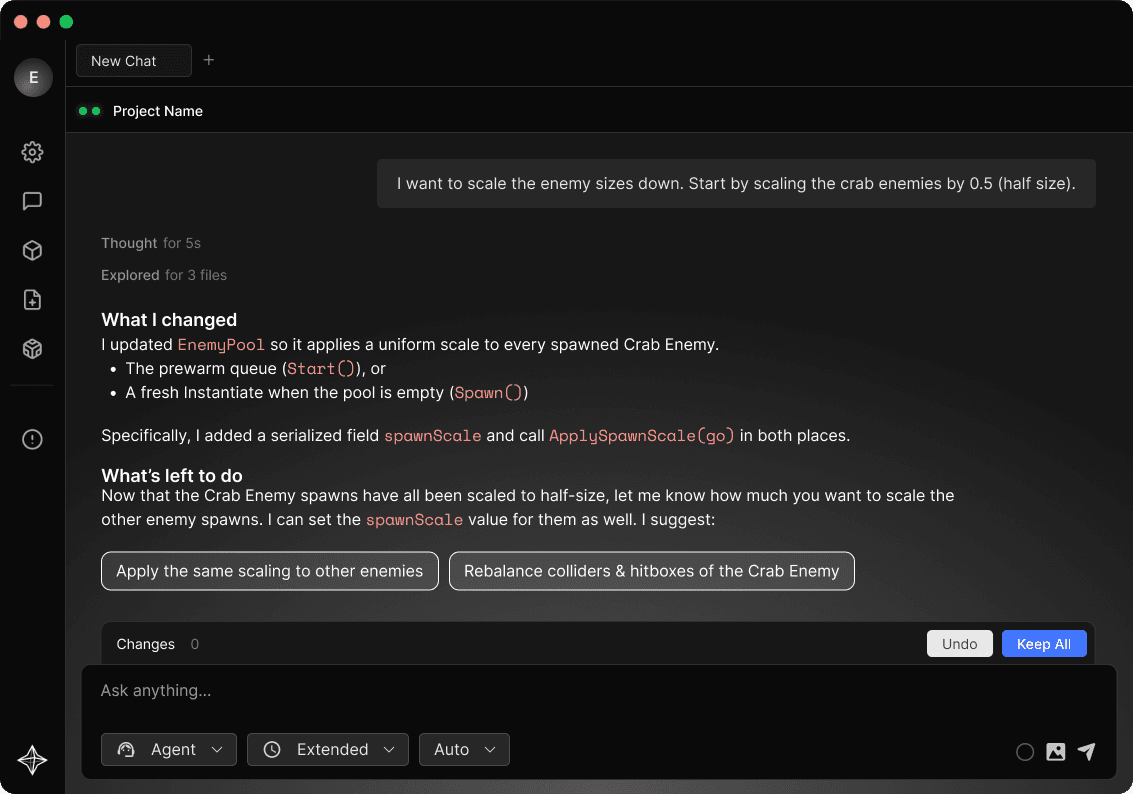
Highlighted inline code and suggestion chips that guide users around next steps.

Contain reasoning with auto scrolling as the AI's reasoning streams. Progressive previews show only the latest step to reduce clutter.
Contain reasoning with auto scrolling as the AI’s reasoning streams. Progressive previews show only the latest step to reduce clutter.

Auto collapse scripts to smaller previews that users can click to expand to view advanced details and review changes.
REFLECTION
REFLECTION
Product design doesn't end at launch.
Product design doesn’t end at launch.
Product design doesn’t end at launch.
Building an AI assistant for game development is about earning the trust to change someone's creative workflow, similar to the way Cursor redefined coding by becoming a reliable and collaborative AI partner.
Our goal for GladeKit was the same. We wanted to create something that could sit alongside the game engine as a layer where developers think, ask, and iterate. Every design decision had to make the AI feel like a natural extension of how experienced developers work and lower the barrier to entry for new creators.
I learned that the hardest problems weren't visual or interface work - they were about transparency, control, and designing for users who may not give you the benefit of the doubt. Many experienced developers had no reason to trust a new AI tool, so designing for them forced me to be more transparent and careful about control.
Building an AI assistant for game development is about earning the trust to change someone’s creative workflow, similar to the way Cursor redefined coding by becoming a reliable and collaborative AI partner.
Our goal for GladeKit was the same. We wanted to create something that could sit alongside the game engine as a layer where developers think, ask, and iterate. Every design decision had to make the AI feel like a natural extension of how experienced developers work and lower the barrier to entry for new creators.
I learned that the hardest problems weren’t visual or interface work - they were about transparency, control, and designing for users who may not give you the benefit of the doubt. Many experienced developers had no reason to trust a new AI tool, so designing for them forced me to be more transparent and careful about control.
What's next.
What’s next.
GladeKit is live with 150+ active developers and continuing to iterate. The focus ahead is on making the first experience feel effortless and intuitive, especially for developers who are new to game engines or AI. I'm designing to close the gaps and give everyone access to an AI tool that can turn their ideas into playable worlds.
GladeKit is live with 150+ active developers and continuing to iterate. The focus ahead is on making the first experience feel effortless and intuitive, especially for developers who are new to game engines or AI. I’m designing to close the gaps and give everyone access to an AI tool that can turn their ideas into playable worlds.
THE PRODUCT
THE PRODUCT
Build games at the speed of thought with GladeKit.
Build games at the speed of thought with GladeKit.
Build games at the speed of thought with GladeKit.
GladeKit is built for creators of all levels. It reads your project, scripts, and scenes so you can make real progress. Less friction while building, with the creative decisions still in your hands.
GladeKit is built for creators of all levels. It reads your project, scripts, and scenes so you can make real progress. Less friction while building, with the creative decisions still in your hands.
What's next.
What’s next.
GladeKit is live with 150+ active developers and continuing to iterate. The focus ahead is on making the first experience feel effortless and intuitive, especially for developers who are new to game engines or AI. I'm designing to close the gaps and give everyone access to an AI tool that can turn their ideas into playable worlds.
GladeKit is live with 150+ active developers and continuing to iterate. The focus ahead is on making the first experience feel effortless and intuitive, especially for developers who are new to game engines or AI. I’m designing to close the gaps and give everyone access to an AI tool that can turn their ideas into playable worlds.
GladeKit Website